Mindset Mouse
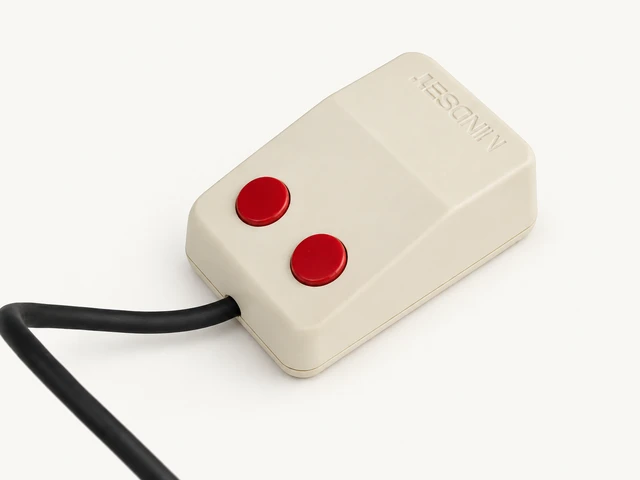
A wedge-shaped case, red buttons and a familiar ALPS mechanism inside.
In 1984, the Mindset Personal Computer arrived on the market — a computer determined to be more than another dull IBM PC clone.
It was a DOS machine built around an Intel 80186, partially compatible with the IBM PC. Its defining feature, however, was a custom graphics subsystem: a dedicated graphics coprocessor could perform operations such as drawing lines, filling areas and moving blocks of an image in hardware. Mindset was designed for sophisticated business graphics, image processing, animation and the coming age of window-based interfaces. The company was even among the manufacturers that announced support for Microsoft Windows early on — although Windows 1.0 did not reach customers until late 1985, when the Mindset story was almost over.
The appearance matched the ambition. The system was designed by a young Robert Brunner, who later led industrial design at Apple. Mindset cases looked more like objects from a design studio than typical early-eighties computer hardware: strict geometric forms, pale plastic, black surfaces and bright red accents. The computer even entered the collection of New York’s Museum of Modern Art.
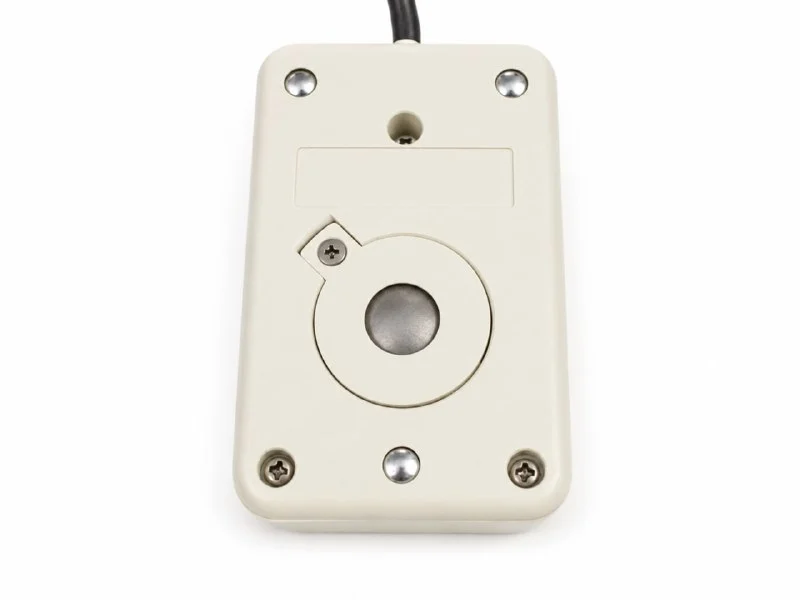
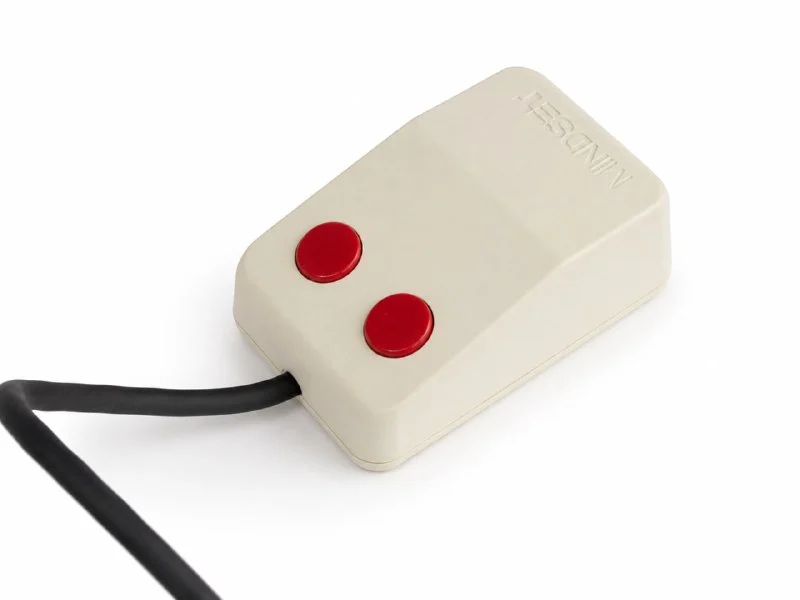
The mouse followed the same design language: a small wedge-shaped case and two round red buttons. Inside, though, there was no special American magic. The actual manufacturer was Japan’s ALPS, using its first-generation platform — a steel ball, substantial rollers and two enclosed mechanical contact encoders.
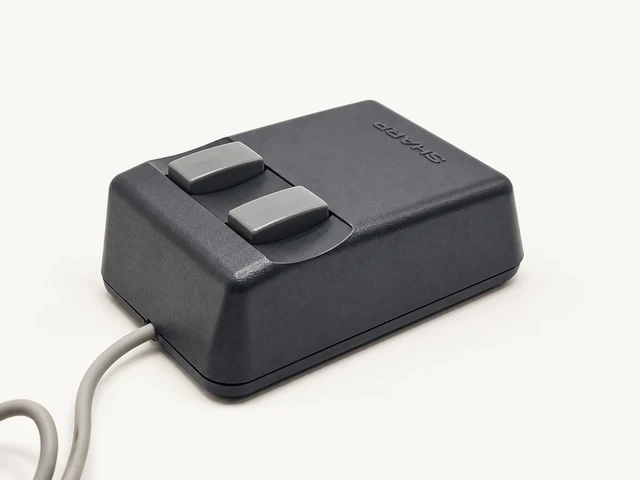
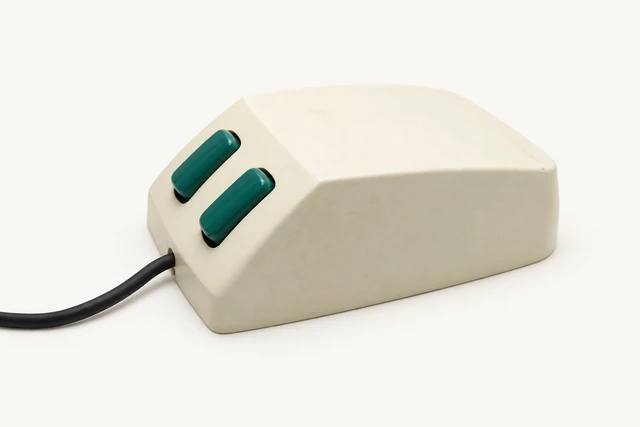
In its construction, the Mindset Mouse is very close to the Sharp MZ-1X10, Microsoft’s first mouse, the famous Green-eyed Mouse, and other mice from the same family. Alps took a practical approach: it reused a proven mechanism, changed the circuit board and interface, and fitted everything inside an entirely new case suited to Mindset’s design. On the board you can spot an Alps signature: wire colours labelled in Japanese characters.
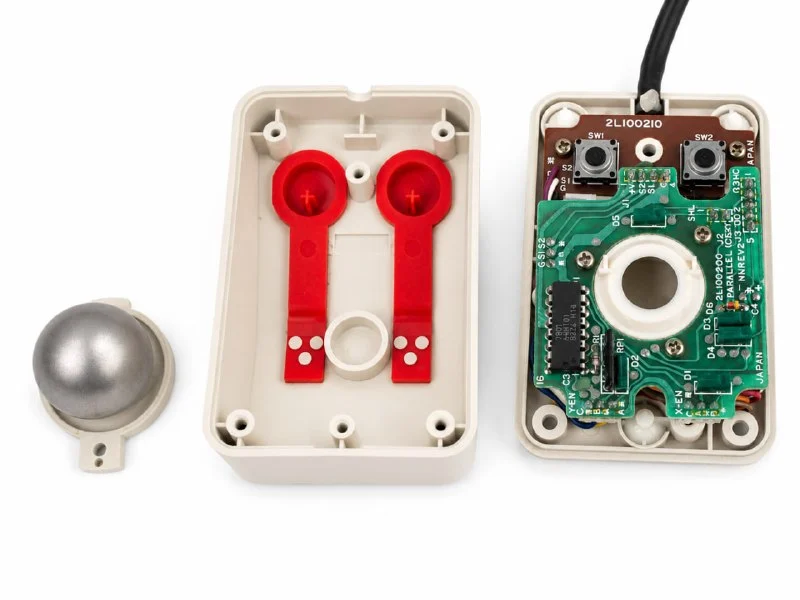
The mouse connected to one of the two sockets on the sides of the keyboard, rather than to the system unit. This was no ordinary serial PC mouse: it sent signals directly from its two quadrature encoders and buttons to the Mindset keyboard controller. A standard serial mouse therefore cannot simply be plugged into it, and the Mindset Mouse cannot connect directly to an ordinary PC.
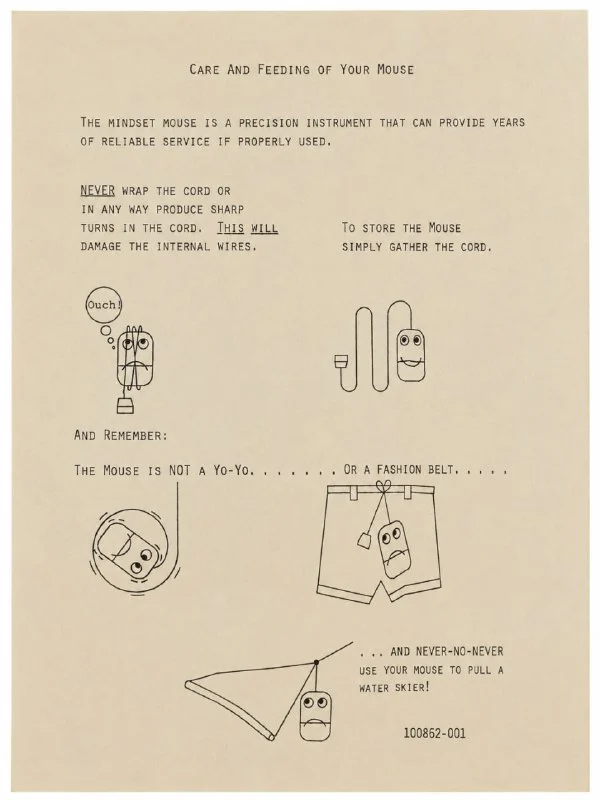
But the best part is the manual, titled Care and Feeding of Your Mouse.
The illustrator turned the actual Mindset Mouse into a little character. Its wedge-shaped body became a face, the two red buttons became eyes, and the lower case seam became a mouth. In the illustrations, the mouse is frightened, sad and clearly suffering from human ingenuity.
Translated from the original Russian post.
Original post on Telegram ↗