
Minsk-32 magnetic-core memory
How a memory cube works and what one Minsk-32 core plane stores.
In 1949 at Harvard, An Wang and Way-Dong Woo invented a new kind of memory based on ferrite magnetic rings. This material could remember data without a continuous power supply, retaining its magnetisation after shutdown.
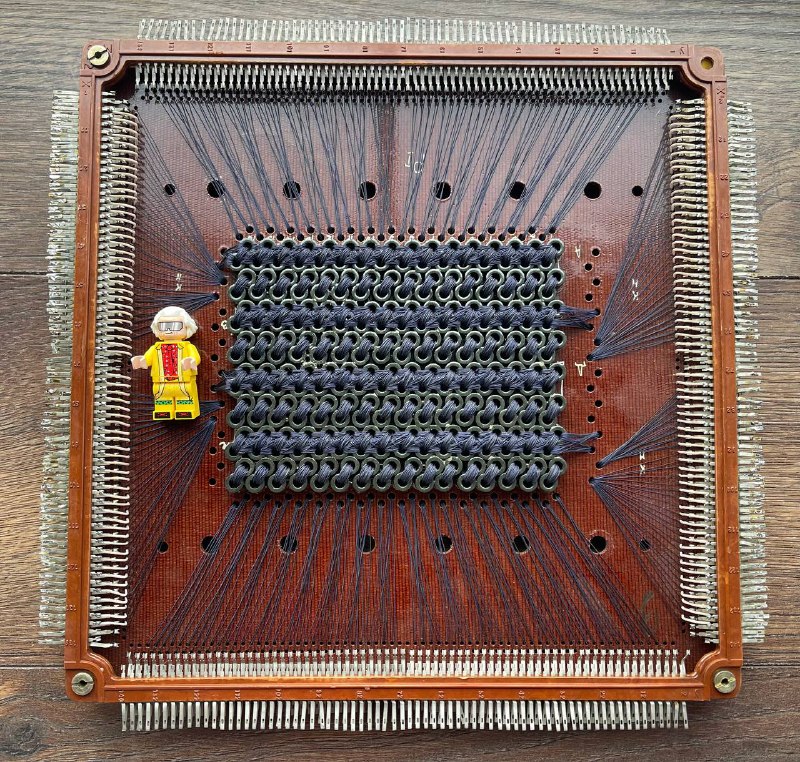
By the 1950s it had become the main kind of computer RAM. It was more reliable than alternatives: resistant to interference, long-lived and requiring no energy to retain information.
Core memory looks like a set of little rings threaded with fine copper wires. The wires form a rectangular grid, or matrix. To address a particular cell, current is applied to a vertical and a horizontal wire. Only the core at their intersection changes magnetisation; the others retain their state.
A two-dimensional matrix is called a plane. Stack several planes and you get a three-dimensional memory array, or cube.
Over time, ring diameters shrank from 2 mm to 0.3 mm, and their switching speed increased thirteenfold. Semiconductors displaced core memory by the 1980s, but its exceptional reliability kept it in aviation and space equipment until the late 1990s. Some onboard computers still use it.
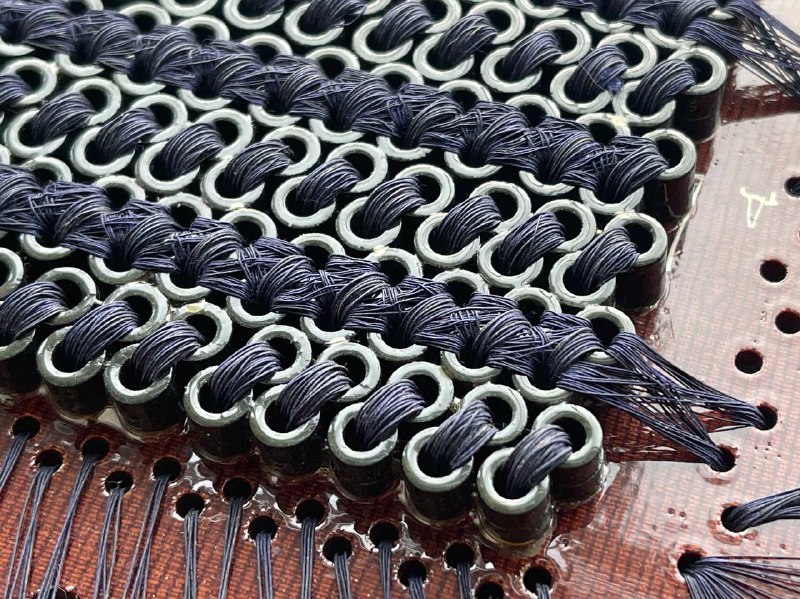
The photographs show a plane from a Minsk-32 memory cube containing 38 such planes. Each vertical line through the cube stored one machine word. A complete block held 16,384 words, about 76 KB. Combining four to eight cubes yielded over 0.5 MB, enormous for the early 1970s.
The first matrices were assembled by hand, like beads on wire. Even after automation, the Russian term for programming ROM, literally “stitching”, remained associated with threading wires through rings.
And core dump, of course, comes from there too.
Translated from the original Russian post.
Original post on Telegram ↗