
IBM Convertible 5140
IBM's first laptop, its expansion modules and an unusual carrying case.
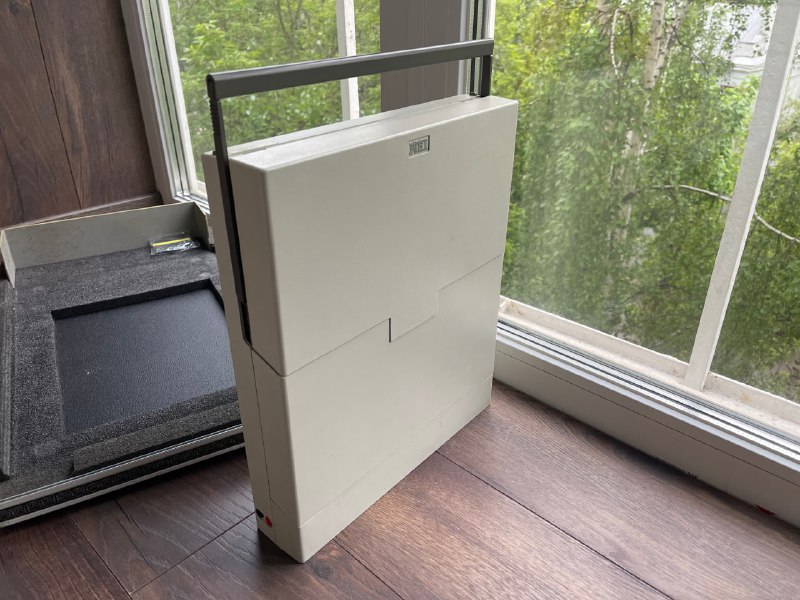
Inside the case is IBM's first laptop, the Convertible 5140, introduced on 3 April 1986.
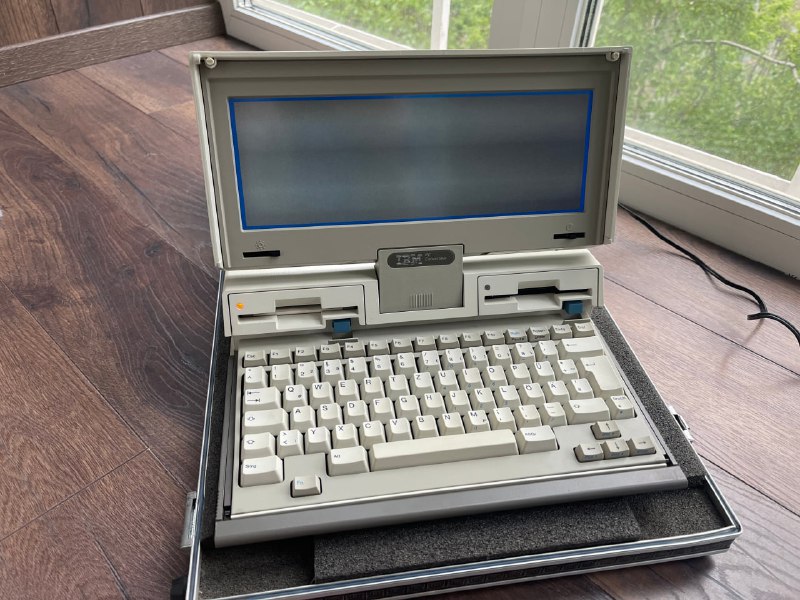
Compared with IBM's previous attempt at portability, the IBM Portable 5155, its six kilograms seem laughable beside 13.5 kg. But the old machine really was 13.5 kg, with only a separate cable to carry. Here you add expansion modules and a rather heavy case.
The case is so indestructible that the laptop travelled safely by ordinary post from Germany to Russia, though that was about ten years ago =)
Amusingly, I haven't seen another sale with this case since, only IBM's soft bag.
Like any 1980s laptop, it has a handle. Opening the lid slightly raises the middle of the case and the keyboard. The designer was Richard Sapper, already known for Compasso d'Oro awards, including one for a coffee maker, and for his work with IBM. With the Convertible, he produced a shape ahead of its time: the austere grey-beige 5140 anticipated the IBM PS/2 aesthetic introduced a year later.
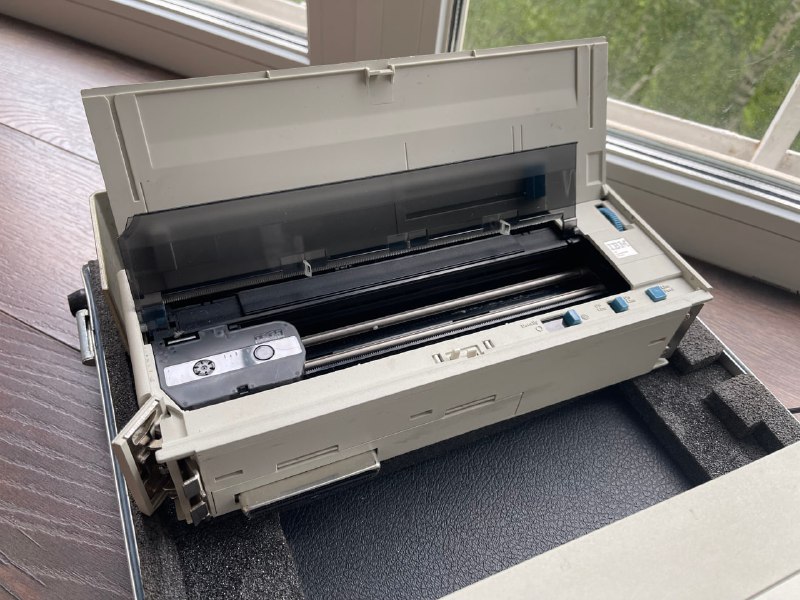
The laptop has no standard ports. Instead, expansion modules attach in a chain at the rear on a shared bus. Mine has a printer. The modules attach firmly and don't come off during transport.
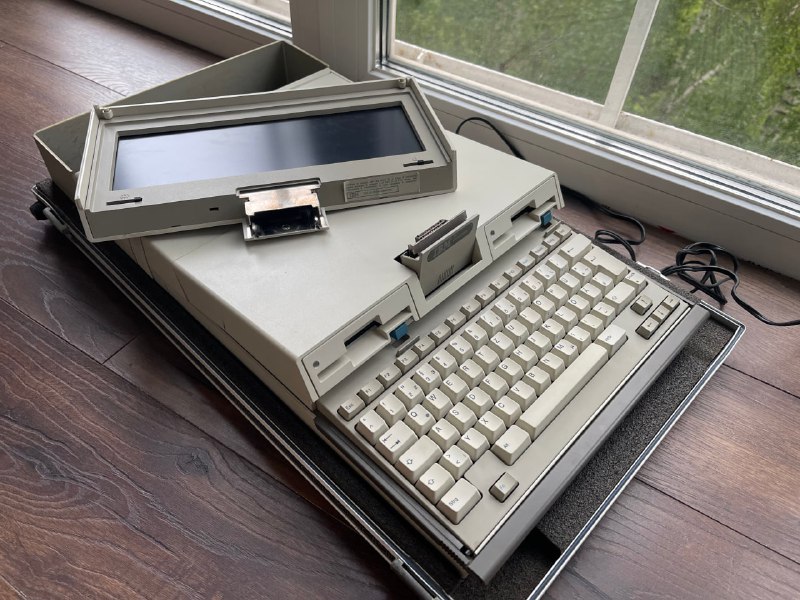
To make it genuinely convertible, you needed an external-monitor module. Together they formed a docking station: remove the laptop display and use it as a full desktop machine. Watch the period advert; attentive viewers will appreciate the automotive reference.
The hardware:
CPU: a sixteen-bit Intel 80C88 at 4.77 MHz. This CMOS chip has a static core that can stop without losing data. It provided IBM PC/XT compatibility, but by 1986 it was outdated: competitors were already using sixteen-bit 80286s. Nevertheless, the CMOS 8088 used less power and enabled power-saving modes.
Memory: 256 KB RAM, expandable to 640 KB. Static RAM was expensive but retained its contents while operation paused. That allowed sleep mode: pressing the power button suspended the system rather than shutting it down, preserving working data. Familiar today, but IBM were the first to think of it then.
Hard drive: none. Instead, two 720 KB 3.5-inch floppy drives. The format was just emerging, and this was IBM's first computer to use it.
Display: a monochrome LCD of about ten inches, showing 80 × 25 characters or 640 × 200 and 320 × 200 graphics. The panel is very wide, making characters look vertically squashed.
Battery life: eight to ten hours! No hard drive, an economical processor and an unlit display.
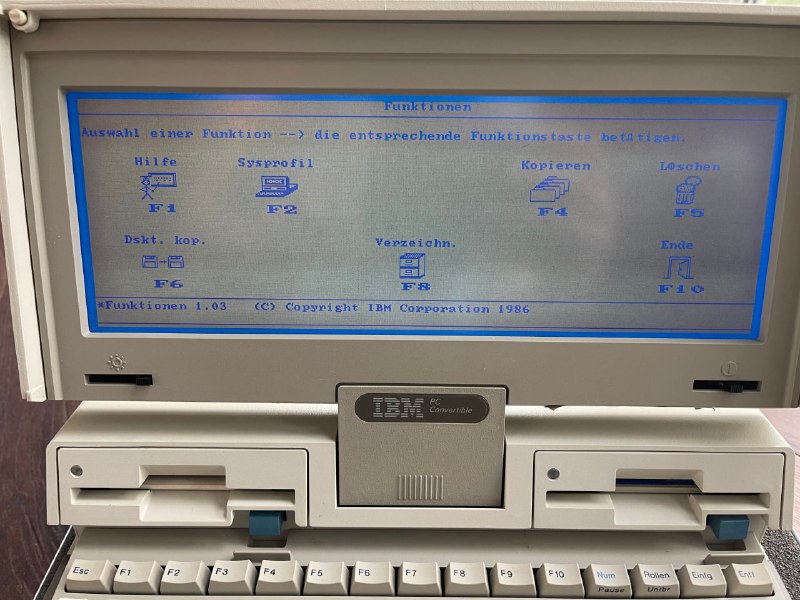
Software: IBM PC DOS 3.2 on floppy disks. For the first time on an IBM portable PC, an icon-based graphical shell helped users launch installed applications without typing commands. It ran over DOS and anticipated later icon-oriented interfaces, making the machine friendlier for beginners.
IBM offered basic applications: a word processor, spreadsheet, notepad, and power- and port-management utilities. The package included a Guide to Operations and demonstration disks.
In the end, modest hardware and a rather poor display. Accounts suggest IBM deliberately avoided top-end components to prevent cannibalising its other computers. Commercially, it wasn't particularly successful; Toshiba and Compaq offered 286 machines with standard ports.
Nevertheless, the IBM PC Convertible earned an important place in industry history. It showed that a complete PC could be portable and battery-powered, and demonstrated the viability of an LCD-and-keyboard form that survives today. Many also consider IBM's adoption of the 3.5-inch floppy a key step towards storage-media standardisation.
Translated from the original Russian post.
Original post on Telegram ↗